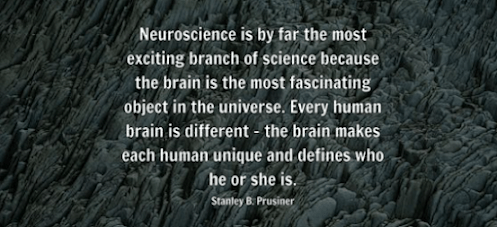
Do you want to know 3 facts about Neuroscience and your amazing brain? Our brains are the fundamental reason for our existence, the most complex known structure in the universe. Exactly what Stanley B. Prusiner says in the quote above, “The brain is the most fascinating object in the universe, the brain makes each human unique, and defines who he or she is.”
Fact #1: The brain is always changing through a process called Neuroplasticity..
The human brain undergoes a process called neuroplasticity, which, by definition, is “A process that involves adaptive structural and functional changes to the brain¹.” Essentially, it’s your brain’s remarkable way of adapting and changing itself to grow, and even pruning connections to new life experiences, events, and so on. The connections and pathways it creates are between neurons. Say you join a new sport, the more you practice and play that sport, the stronger that neural pathway will become. The same applies if you quit that sport; the neural pathway will become weakened. This process heavily impacts our developing self, our new interests, and personality changes.
Fact #2:The brain cannot feel pain…
Isn’t that pretty cool? Though our brains can process pain signals from other parts of our body, the human brain doesn’t have any pain receptors. Let’s put it simply, our body contains nerves that have unique sensors referred to as “Nociceptors” that react when you get a cut or a burn. Our brain doesn’t contain these sensors. Say you get a paper cut on your finger, the nociceptors in your fingers sense what they believe to be potential damage, and send a signal up your nerve, which travels through the spinal cord to your brain. Once the brain receives the signal, it will process it and compare it to similar experiences in the past. The remarkable aspect of this is that the pain isn’t actually coming from your finger; rather, the brain produces that sensation in response to the message it receives.
Fact #3: Our brain cannot actually multitask!
Hold on, that doesn’t seem true. I mean, I’m sure everyone has watched TV and done their homework at least once in their life, right? Actually, it’s kind of an illusion. The brain jumps back and forth between the tasks you are trying to complete. This process is called “Task-switching,” and it’s not as easy as it may appear. When you did your homework and watched TV, the brain didn’t let go of one of the tasks that you were previously doing; it actually had remaining thoughts about the first task, which made it harder to concentrate on the next thing you were trying to focus your attention on.
In summary, the human brain has so many more interesting facts that adhere to our self-development and neuro-wellbeing. It is so interesting to keep learning about these interesting processes that happen in our brains without us even really knowing. Keep discovering more about your amazing brain!
– R.J.
**Resources:**
 Neuro-Wellbeing & The Developing Self
Leave a comment